Wednesday, February 27, 2013

The golden rule

Treat poeple the way you would want them to treat you.


 When you screw-up, fess up, and move on.


Give a full day's work for a full days pay.


Take time to laugh every day.


Friday, February 1, 2013

How do I change a flat tire?

      How to change a Flat Tire


Step One: Setting the scene

Scene is safe. Flat tire or not a vehicle needs to be  in a safe spot before you can attempt repair. Try to start out in a fairly level  place well out of traffic. A car can be moved a short distance on a flat at very low speeds, think football fields not 1/10s of miles. If you are on the side of the road make sure your flashers are on.


Step Two: Safety

  Put on emergency brake and straighten front tires - put an automatic in park, low gear or reverse for a standard transmission. - You don't want your car to roll while there's no a tire on it.


Step Three: Inventory

  Do you have a jack, spare, lug wrench, something to get hubcaps off with? You can not do much of anything without the right tools. Have them in reach and not in the car or truck, once the tire is off you don't want to be bouncing the car around while it is on the jack. Passengers should know to get out or sit still while you are changing the tire.


Step Four: Using your tire tool

  All cars have lug-nuts  some you have to take off a hubcap to get to. A screwdriver can usually be used to pry at the edge og a hubcap at short intervals all around until it comes loose. Once you can see the lug-nuts you will put your tire tool on the lug-nut pointing at what would be 10 o'clock on a clock face. This allows you to push down on the end of the lug wrench or even step on it if you aren't strong enough, just be careful to ensure it is on well before you exert maximum force or you could brake the lug or strip the lug-nut. You should be able to turn them 2-3 turns until they become easier to tun then stop you have to jack up the vehicle before you go any further. 


Step Five: Using the jack made for your vehicle

  I wont go into this cause there's too many jacks that all work differently for different vehicles
- jack up the corner of the car where the flat is. Try to make sure the ground under the jack is solid
so it doesn't sink in the mud as it lifts the corner of the car. A short length of board can be placed under a jack in some cases to help support the jack.  Jack the car up just enough to fit the spare on - the higher the less stable and less safe.


Step Six: Take Precaution

Finish loosening the lug nuts and wiggle the flat off of the studs. Being careful not to bump the jack slide the flat under the car as an additional safety if it were to fall off the jack. Do no place your arms legs or torso or head under the car or suspended axle. 


Step Seven: Putting spare on studs

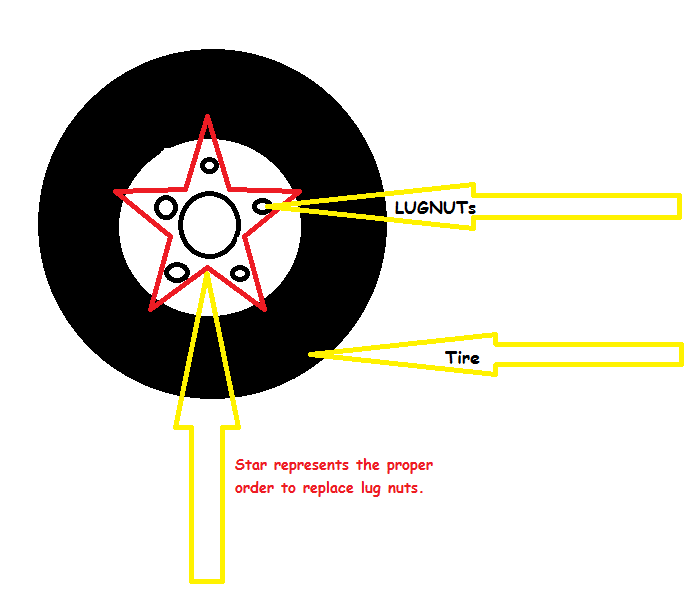
Align your spare tire up with the studs and lift it into position -don't jostle or bounce the car while pitting it on. Start one lug-nut, being careful not to cross thread it and tighten it with the lug wrench until it is just past finger tight. Then start one straight across from it and continue in a star pattern pulling the wheel squarely onto the axle. Once all lug-nut are on and just past finger tight start over and tighten them pretty tight and finally one more time around tightening them to the manufacturers recommended  torque. Don't overt-tighten or the studs may break.


Step Eight: Now you are ready to pack up and hit the road. 

Drag your flat out from under your car and slowly let down the jack. Pack up all your tools and hubcap. Don't forget your flashers are on you can turn them off now and let off your emergency brake.Go carefully down the road to get your tire fixed or a new one. Remember you don't have a spare now and you may have not gotten your lug-nuts tight enough. If your spare is a temporary or donuts sized spare you must not exceed the speed that the spare was rated for and your auto will handle different with the odd ball spare. Good luck!

-->


How do you weld?

I recently learned how to weld  and , I am far from an expert but I can tell you how I went about it.

I learned on an arc welder , also called a stick welder.

Welding is the fusing of two pieces of metal together by melting them and an electrode with high voltage electricity.

Welders have two leads (wires coming out of them)-a hot and a ground.

The ground connects securely to one of the pieces you are wanting to join together. you may have to use a grinder or wire brush to make sure it is connected to metal well and not grease or rust or dirt.


Once the ground is connected you should secure a welding rod in the lead.  One end of the rod has no flux on it this is the end that is pinched int the jaws of the lead. All rods have numbers on them that specify how many pounds per inch a properly welded connection will hold.  i have used rods that start with 60 or 70 there is a chart on most welders saying what setting the welder should be set on to weld with certain rods. There is a second set of numbers also that specifies what kind of flux is on the electrode and what it is good for.

6011 or 6013 is a good rod to learn on 7018 is a little harder to work with but makes an extra strong bond.

Flux is the coating on the electrode  The reason flux is on the rods is --as the electrode melts the flux burns intensely creating an oxygen free zone over the molten metal and also preventing the molten electrode from sticking to the weld.

You want to always wear darkened eye cover while welding because the intense light can damage your eyes.

So what happens is when the electrode contacts the the metal that is attached to the ground a circuit is closed causing lots of energy to stream through. Electric energy creates heat when it moves and the tip of the electrode will be the smallest place and thus the most concentrated amount of heat. As the heat cooks the flux it boils and the boiling flux melts the metal, the electrode , and the other piece of metal all into a tiny pool or drop of molten metal.

That tiny bright red pool is where the magic happens because, as the electrode melts, tiny gaps open up between the new end of the electrode and the drop of molten metal. The electricity jumps (or arcs) from the electrode to the pool. This ark is hot as lightening - hotter than the surface of the sun. This arc can be aimed to send the heat deep into the two pieces you are joining melting the surface and the two molten surfaces and the metal from the electrode join as new metal. As the new metal cools imperfection come to its surface.  The impurities take the form of a carbon type substance called SLAG. Slag protects the cooling  weld and then is chipped off with a tiny pointed hammer or grinder to re-weld, most large welds require several passes to make sure there is enough metal n the joint to hold tight.


Thursday, January 31, 2013

Where does lumber come from?


Lumber comes from trees and trees come from the forest. It takes years to grow trees.


In order to ge tto the trees roads must be built

Sometimes equipment is built to help load the logs ,once cut, onto trucks and trailers to remove the trees from the forest.


 Logs are then loaded onto the sawmill and sawn into boards.


Sunday, January 27, 2013

Leasing and fleecing and guardianship..

 As neighbors go sheep farmers are usually as good as you can expect. They mind their own business and, apart from doing away with neighborhood dogs that pester their flocks, they  don't bother anyone.  This being said I will expand to say I have neighbors who are sheep farmers and one particular neighbor sheep farmer who sold his farm and is between farms for a while but still owning some livestock approached me about expanding one of my paddocks and supplying hay for my goats and his few head of sheep until he can find a more long term solution.  I have have been wanting to add sheep into the mix here at the Hinton Homestead so I obliged him. We spoke little about specifics as I am mainly out to do a favor for a neighbor and in the process learn about sheep. We approximately doubled the size of the paddock, I decided it would be wise to move the goats into a new paddock and shed as they have been showing signs off illness and I did not want to make the sheep sick.  I sprayed the old paddock down with bleach as an additional precaution and he moved his flock  . The first day we moved them and moved some hay and the fence they seemed to work out well but the next evening, when i came home from work,  I found a very small lamb laying cold and limp in the grass and, despite bringing it home and warming it, It was lifeless.


Fast forward a week, the sheep farmer has been steady moving hay and feed and making improvements a hoop house ( an idea he borrowed from me a few years ago) and brought his guard dogs to stay with the sheep.
There is a young wether (castrated ram) with a huge gash on its front shoulder. I have had goats in the barn and paddock for over a year and never a scratch and now this sheep has a life threatening gash in less than a week. I  walked every bit of the field and barn and found the offending piece of tin in the barn and covered its edge with aboard to prevent more such injuries.

This past weekend was a bitter cold morning in the low 20s and  another ewe dropped  lambs , this time they were both alive when the sheep farmer discovered them. I had slept in for once.  There was a whit lamb and a black lamb the white one was doing fine bt the black one was weak and shivering and wouldn't stand.


After putting as much time as possible into trying to allow the ewe to warm and feed the black lamb it was decided that he was going to die if we didn't bring him in and warm him up .


We very nearly waited too long but after a few spoonfuls of sugar water , lots of rubbing and working his muscles, drying him off,  and a gradual warming up in front of an electric forced air heater he was sitting up and trying to stand. Then after some syringes full of milk and sugar water he finally, shakily, stood up. The sheep farmer brought a bottle and powdered milk, milked out some colostrum from the ewe and we had him fed about 3 8 ounce bottles by the end of the day.


Then the next morning after bleaching, scrubbing, and mopping about 36 ounces of lamb associated urine and fecal droppings from the downstairs bathroom we found him to be a voracious eater. He seems to like people and pooping. He would not try t o nurse his mother when reintroduced and she wouldn't allow him to nurse when I put them together physically. So it looks like we are stuck with him.bottle feeding, in the house, until he is a couple weeks older- it is supposed to be icy and cold for the next 7-10 days. That will teach me to sleep in and not check on the sheep every morning. 


But really it isn't too bad aside from the crying and the pooping everywhere. That is all part of farming and part of being a good neighbor. I will try to get up early, even on my days off and check for lamb,s cause it is a lot easier to get them up and nursing then it is to keep them alive without the mother helping out. 


This whole sheep raising idea has been a bit of an adventure and I am not entirely sure what the total equation looks like dollars and cents. Dead and sick sheep , feed bill taken over by someone else, and lots of poop in my floor are all things I never would have figured on if I had quoted a simple dollar price for keeping the animals. Livestock gets sick and livestock becomes dead stock that's part of farming. I could have been up at dawn to find the same lambs had been thrown at  2 am.. 


.  

Thursday, August 23, 2012

Sweet Spots

When you go to the beach and want to go out and play int he waves there is a spot , about neck high, where you are lifted by the waves and placed gently back on the sand. Further out you are dropped in water over your head, further in you are not lifted but bashed by the waves. That is your sweet spot.

When you are drilling holes in metal with a drill press you hold down with a certain amount of pressure and the shavings fly out of the holes. You hold down too hard and the bit smokes and then locks up. If you  hold down too easily and the drill bit just polishes the bottom of the hole refusing to cut. That perfect amount of pressure is your sweet spot.

Life is full of sweet spots and they are constantly moving. Just when you think you are in one everything changes and you are struggling to find the next sweet spot.

Businesses have sweet spots too, a certain product line or niche that they are specifically designed for , right place, right time, right product, right human resources and capital to pull it all together.  It is important to recognise when your business hits that sweet spot and know when to stop changing things. Thats the challenge perosnally and professionally know ing when it isn't going to get any sweeter.

You don't want things to put you in over your head or things to be grinding to a stop so always be aware and looking for your organizational and professional sweet spots and when you find them cherish them because they are few and far between.

Sunday, August 5, 2012

Homesteader got married.

 On July 21 I became a married man.

 Here is my full family, together and happy for a while. We are never sure what the future will hold so its important to try not to get too wound up in plans and goals and forget to embrace what you have at any given time.  Dark days have come and gone and hopefully brighter ones are still ahead. The farm is not doing so well as disease ran rampant through the goats and destroyed my flock. The geese and chickens are doing tolerably well but te Sawmill coming together is the real news. 

I have been cleaning up the mess the dozer made and it is fantastic to have a decent road but the dozer destroyed so many young trees in making the road. I am harvesting them all for firewood and smaller logs. New wife and I have been working all weekend on cleaning up felled logs and damaged trees. We also expanded the clearing to have room to put the mill.


I have been examining better chainsaw chains, there are options for high speed steel or carbide tipped chains that could last longer between sharpening but they cost a lot more and require special diamond encrusted wheels to sharpen. I hate to sharpen saws and because of the dirt and the extreme hardness of locust and even red oak on the new property made short work - less than two tanks of fuel through saw and it was already dull. I bougth he best saw value I could a Makita 6421- from Bailey's logging supply. Ialso got a portable winch. I am planning to use them to keep the sawmill fed every weekend with mature and diseased trees off my two parcels of property.

My new wife tells me it is bedtime and she is tired after a day of cutting firewood and stacking up logs. So I'll post again sometime soon.